Back in 2024, I was hiring a head of content marketing at PhantomBuster. I interviewed around 30 people and saw a wide variety of profiles.
Most of them could tell me what great content looks like, and most could tell me how they'd create it.
The one who stood out told me how she'd build a system to produce it: the procedures, the automations, and the points where a person has to check the work. She looked beyond the article at hand - she obsessed about the system she had to build, and how it could drive revenue. I hired her.
Today that way of working has a name. A content engineer is a marketer who builds the systems that produce, check and update a company's content, and keeps improving them.
To see what sets these people apart, we at Sighted compared the LinkedIn profiles of 50 content engineers with 200 content marketer profiles. Here's what we found, and what it means if you're thinking of hiring one or becoming one.
Key findings
- Both groups mention writing about equally often: 60% of content engineers and 63% of content marketers.
- 78% of content engineers mention workflows or automation. 14% of content marketers do.
- 34% of content engineers mention quality checks or fact-checking, compared with 3% of content marketers.
- 50% of content engineers name Claude on their profile. Only 2% of content marketers do.
- Content engineers are more than twice as likely to have a degree in computer science, engineering or IT: 16%, compared with 6% of content marketers.
What is a content engineer?
A content engineer is a marketer who builds and improves the systems a company uses to produce, check and update its content.
Content engineers still write. But most of their work is deciding how articles get made: where the facts come from, what the AI writes, what gets checked automatically, and where a person steps in.
The title is older than the role. Technical writers have used "content engineer" since at least 2013 for someone who structures documentation. Marketing teams picked it up in 2025, when AirOps and Jasper began using it for marketers who build AI content systems.
The older meaning still dominates on LinkedIn. We went through more than 500 profiles for this study, and many of the people who came up under the title do the older, documentation kind of work. We did identify though 50 content engineers doing the most advanced work in the marketing role. They're the basis of this study.
Why companies are hiring content engineers now
Companies are hiring content engineers now because content teams have to do more, with less. Until recently, a content team only had to worry about Google. Now it also has to worry about being visible in ChatGPT, Gemini and other LLMs. The two overlap, but LLMs put a bigger emphasis on three qualities in your content.
It has to be fresh. AI assistants show a clear bias towards recent content. In an AirOps analysis of the pages they cite, more than 70% had been updated within the past 12 months. Freshness helps LLMs give what they believe to be a more accurate answer. It also puts a heavy load on content teams: keeping pages fresh added to the workload of the content managers we interviewed.
It has to be consistent and accurate. LLMs want to give their users trustworthy information, and one signal of trust is a consistent message. When your website and the pages other people write about you say the same thing, an LLM can reconcile the facts about your brand and rely on them.
Consistency also helps an LLM answer better. It can treat your company as one clear entity, meaning a named thing it can recognise and describe. So when it does talk about your brand, it says what you want it to say.
It has to be unique. Google has a name for what it wants for its AI agents: non-commodity content, meaning content with a unique perspective and real first-hand experience. Now that anyone can produce a passable article with an LLM in minutes, that kind of content is what stands out, to Google and to AI assistants.
Keeping hundreds of pages fresh, consistent and unique by hand requires huge teams of content writers and editors. Yet at the same time, AI means marketing teams are expected to do more with less. Gartner's 2026 CMO Spend Survey of 401 marketing leaders found 56% of CMOs short of the budget to deliver their strategy.
Content engineers are hired to solve this problem. They use AI to build the systems that help your brand consistently rank in Google and be recommended by LLMs.
What does a content engineer do?
A content engineer builds the systems that keep your content fresh, consistent and unique at scale.
The systems a content engineer builds
A content engineer builds one part of the system for each of three needs: freshness, consistency and uniqueness.
- For freshness, a flow that brings new facts in and flags every page that uses a fact when it changes.
- For consistency, one store of approved facts. Some teams keep it as a second brain of organised documents, and others use a database. Next to it sits a brand truth: several canonical documents that say what the company is, who it's for and what it wants to be known for. These knowledge bases feed AI agent approved information, reducing errors and inconsistencies.
- For uniqueness, a pipeline that runs from that fact store into every article. It carries the facts only your company has onto the page: your customers' words, your own data and your team's opinions. The system also marks the points where a person steps in, so an editor can add the anecdotes, stories and humour that help the brand stand out.
Building these is the content engineer's job. Day to day, it means:
- connecting tools so that data can move between them, through APIs and integrations
- building the database that holds the facts
- deciding where a person has to step in
- setting the goals and instructions each AI agent works from
- fine-tuning what the AI is given, so that results improve and cost falls
An example: the content system Adina built
Adina Timar, the head of content I hired, and a certified content engineer, now runs a content system as Head of AEO at Weflow, and builds them with me at Sighted. She describes it in full here, in a piece she wrote with Maja Voje for GTM Strategist. It runs as a loop:
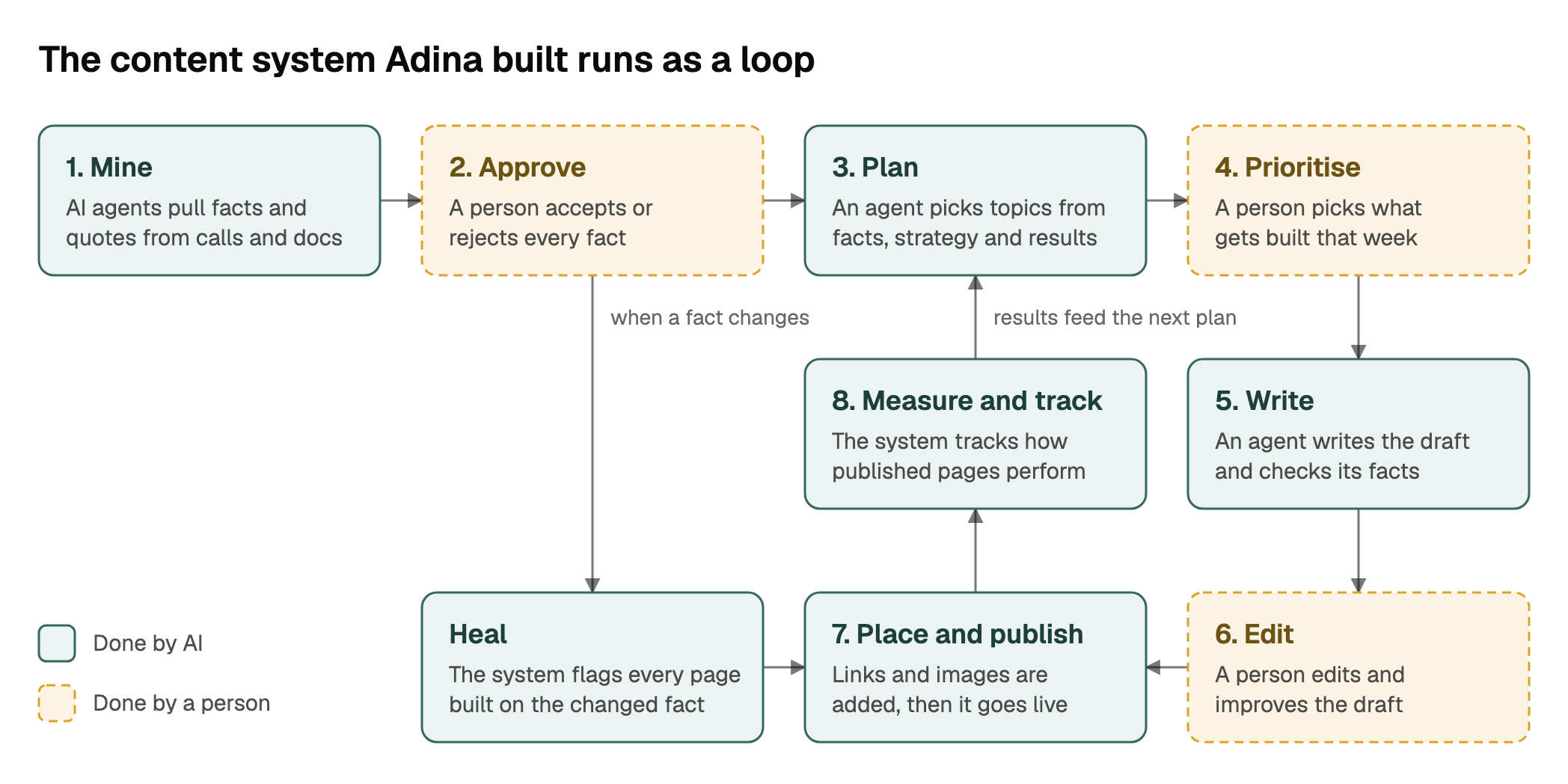
- Mine. AI agents pull facts, quotes and customer problems out of sales calls, podcasts and documents.
- Approve. A person accepts or rejects every fact.
- Plan. An agent proposes topics from the approved facts, the strategy and the results of published pages. It only proposes topics with enough approved facts behind them.
- Prioritise. A person picks what gets built that week.
- Write. An agent gathers the evidence, writes the draft and checks it against the stored facts.
- Edit. A person edits and improves the draft.
- Place and publish. Links and images come from stored lists, the page goes live, and the system records which approved facts the page used. That record is what makes the Heal step below possible.
- Measure and track. The system tracks how published pages perform, and the results go into the next plan.
One more step, Heal, sits outside that order and watches the fact store. When an approved fact changes, the system looks up every page that used it, rewrites the passages built on the old fact, and sends each page back through step 7.
A system like this also lets you scale production. Adina oversees the whole loop at Weflow on her own. In the same role, she used to lead a team of 15 people. Now she doesn't need anyone else.
Improving a content system over time
A content system is never finished, because the AI models and the company's facts keep changing.
Adina has rebuilt the way her system extracts and stores facts three times:
"I changed it three times at Weflow, and it definitely had an impact on how I'm retrieving data and how the agent interpreted it."
Adina's first versions copied sentences out of a source and rewrote them. The current one looks for patterns across sources, and separates a fact worth storing from an insight for the team.
Once she'd reworded the stored facts, she had fewer edits to make on every draft.
What is the difference between a content engineer and a content marketer?
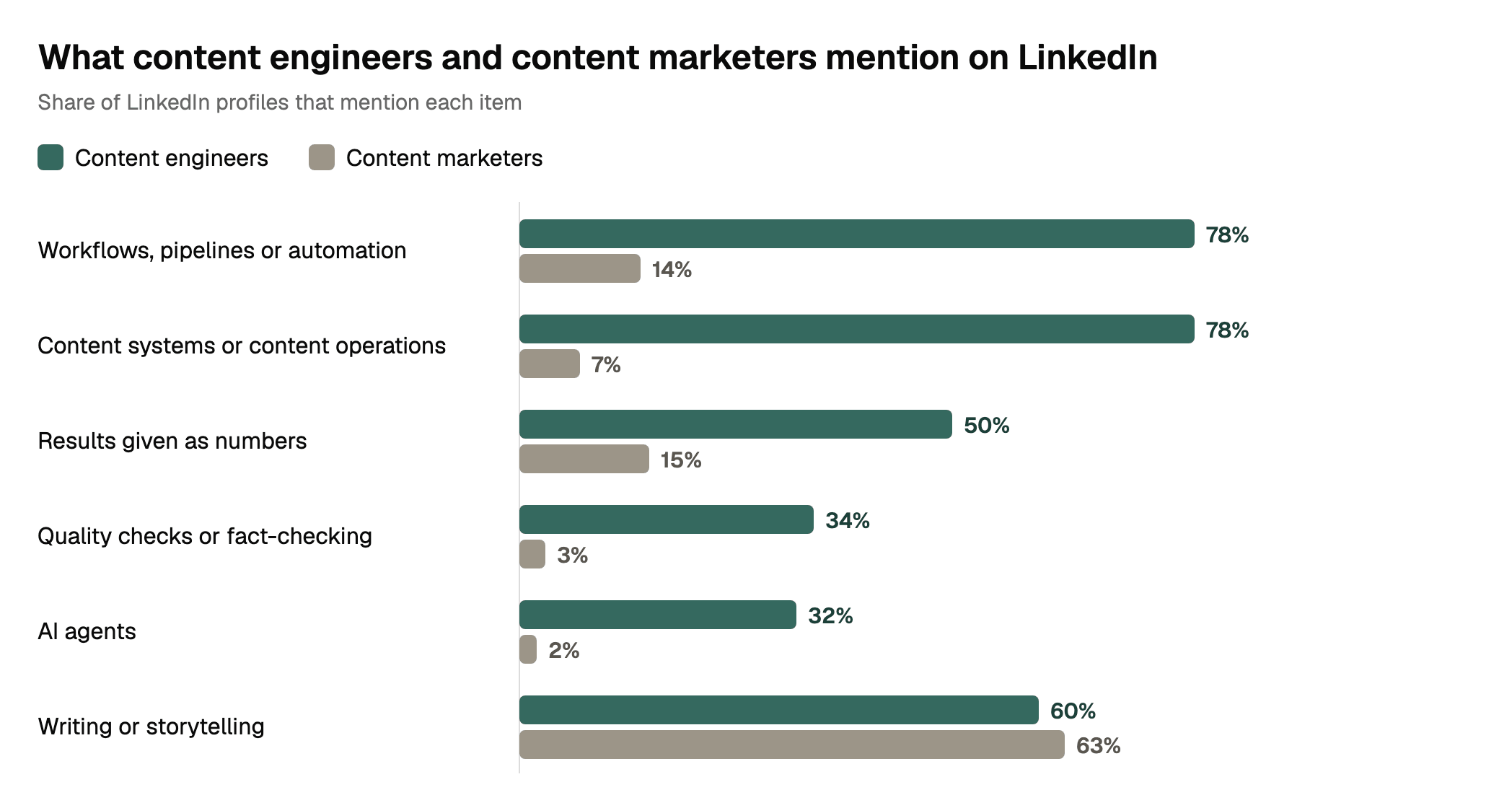
The difference between a content engineer and a content marketer is that the content engineer builds systems. In our comparison of 50 content engineer profiles with 200 content marketer profiles on LinkedIn, 78% of content engineers mention workflows or automation, compared with 14% of content marketers. What the two groups have in common is writing: a similar proportion of each mentions it, 60% and 63%.
| Mentioned on their LinkedIn profile | Content engineers | Content marketers |
|---|---|---|
| Writing or storytelling | 60% | 63% |
| Workflows, pipelines or automation | 78% | 14% |
| Content systems or content operations | 78% | 7% |
| Results given as numbers | 50% | 15% |
| Quality checks or fact-checking | 34% | 3% |
| AI agents | 32% | 2% |
Do content engineers still write?
A similar proportion of content engineers and content marketers mention writing or storytelling in their LinkedIn bio or their most recent job descriptions: 60% and 63%. So we can assume that not much has changed here.
Where I do see a change is in the kind of writing. In the teams I've run, a content engineer writes fewer first drafts and spends more time fine-tuning one: bringing in a human voice and building the brand.
What skills does a content engineer need?
Three skills set content engineers apart: building workflows, running content systems and checking quality. 78% of content engineers mention workflows, pipelines or automation on their LinkedIn profile, compared with 14% of content marketers.
The gap is wider still for content systems and content operations: 78% compared with 7%.
Content engineers also describe their results differently. 50% give at least one result as a number, compared with 15% of content marketers. That suggests they're used to measuring a process that's built to impact revenue, where a content marketer more often describes the pieces they've written.
34% of content engineers mention quality checks or fact-checking. 3% of content marketers do.
Quality checking is the least visible part of the job and, I'd argue, the most important. Once AI writes the first draft, someone has to decide what gets checked, by what, and when a person looks.
Job postings support our findings. Of the 20 content engineer job postings we read, 15 name quality checks on AI output and 10 name a step where a person reviews.
Does a content engineer need to know how to code?
In most cases, a content engineer doesn't need to know how to code. But far more content engineers mention code on their profile than content marketers do. A third of content engineers describe building tools or working with code in their bio or job descriptions, most often by naming Claude Code. No content marketer in our sample does. In the skills list of their profile, 32% of content engineers name a programming language or a coding tool, compared with 7% of content marketers.
Few have a technical degree. 16% of content engineers studied computer science, engineering or IT, compared with 6% of content marketers. 40% studied journalism, English, writing or communication, close to the 48% of content marketers who did. Another 18% studied marketing or business.
With vibe coding, what matters is systems architecture and systems thinking, more than writing the code yourself. Content engineers share that way of thinking. They enjoy fine-tuning a process, they can hold the whole system in their head, and they care about repeatability as much as creativity.
What tools do content engineers use? Mostly Claude and AirOps
Content engineers mostly use AI assistants and AI workflow tools, or wrappers. On their LinkedIn profiles, 50% name Claude, 40% name ChatGPT and 34% name AirOps.
| Tool | Content engineers | Content marketers |
|---|---|---|
| Claude | 50% | 2% |
| ChatGPT or OpenAI | 40% | 6% |
| AirOps | 34% | 0% |
| MCP, a way of connecting an AI model to other tools | 16% | under 1% |
| n8n | 10% | 0% |
What a content engineer needs most is to understand how information is organised: what counts as a fact, where it's stored, and how the AI finds it.
How we compared content engineers and content marketers
Sighted collected LinkedIn profiles from three searches for content engineers in November 2026. We kept 50 people who either hold the content engineer title in a content marketing role or describe themselves as such in their title. We compared them with 200 content marketer profiles, and counted how many in each group mention each thing in their bio, job description or skills.
Content engineer vs. marketing engineer vs. GTM engineer
Content engineers, marketing engineers and GTM engineers all build systems with AI. They differ in which team they build for.
| Role | What they build | For | Where the name comes from |
|---|---|---|---|
| Content engineer | AI systems that produce, update and check content | The content team | Technical writers used it from at least 2013. Marketing teams adopted it in 2025 |
| Marketing engineer | AI agents for all of marketing, such as monitoring competitors and reviews | The marketing team | Profound introduced the role in April 2026 |
| GTM engineer | Lead scoring, lead routing and automated outreach | Sales or revenue operations | Clay named it around 2023 |
A content strategist is different again. The strategist decides what to make, and the content engineer builds how it gets made.
Do you need a content engineer or a great writer?
You need both a content engineer and a great writer. A content system can spread your story, but it can't come up with one.
The case for the writer is strong. A great writer is harder to find and harder to replace than someone who knows the tools.
But I don't think you have to choose. A content system brings the cost of each article down, and that saving is what lets you afford both. At one B2B SaaS company I worked with, the full cost per article fell from about 500 euros to under 200 euros within six months of building a content system. That figure includes the writer's fee, the tool subscription and staff time.
The AI usage itself cost about 10 to 15 dollars an article, if run directly in Claude Code. The saving came from the writers, who stopped starting from a blank page and began editing a good draft.
This is the kind of content system Sighted builds for early-stage B2B tech companies.
Should you hire a content engineer, appoint one or use an agency?
Keep your writer in-house, and choose separately whether to hire a content engineer, appoint one or use an agency.
A writer needs to know the product, the customers and the company's opinions, and that takes months. The content engineer who builds the system can come from outside, because they can learn what they need by asking the right questions.
That leaves three options:
- You can appoint someone on your team. Pick a person who already thinks in processes, and give them the time.
- You can hire a content engineer. It makes sense once you want to publish at scale and have enough stories to spread. Gallium, rightfully, warns that hiring one before your message is clear gets you a machine with nothing distinct to say.
- You can bring in a specialist for the build. Peter Springett suggests the role can start as a part-time hire for three months. An agency can do the same, then train your team to run the system.
A disclosure: Sighted is an agency that builds, runs and hands over content systems for early-stage B2B tech companies, so I have a stake in the third option.
Will the content engineer role last?
I think the work of a content engineer will outlast the title.
The most vocal argument against it came from Ryan Law at Ahrefs. In 2025 he compared the content engineer to the prompt engineer: a role that fades once the tools do the job themselves. He had a point. Building a workflow gets easier every few months.
But the actual building is the smaller part. Content has become a system, and systems need engineers. LLMs write excellent code, yet companies still employ software engineers, because someone has to decide how the parts fit together, where the data flows and what happens when it breaks. Once your pages come from a flow of facts, in from sales calls and documents, out into drafts and back for repair, you are running a data system. Whoever keeps it healthy must think like an engineer, whatever the job title says.
And as models change, and new tools appear, last quarter's system will need fine-tuning. Like software, the system will constantly need improving and maintaining.
Demand points the same way. In Jasper's survey of 1,400 marketers, 19% said they plan to hire a content engineer in the next 12 months.
Ryan has since ended up rebuilding Ahrefs' content process himself, and is on a third version, which he now runs like a content engineer with Claude Code.
What the person is called in five years matters less than whether someone owns the system.
FAQ
AirOps and Jasper each run a content engineer certification. About 8% of the content engineers in our study state on their profile that they're certified.
AirOps, citing Glassdoor, puts content engineer salaries at $120,000 to $165,000 a year, and $160,000 to $220,000 for senior roles.
To become a content engineer, add three habits to a writing background: thinking in systems, building one step at a time, and measuring. Most content engineers were content marketers first. In our sample, 40% studied journalism, English, writing or communication, and only 16% have a technical degree. So the way in isn't a coding course.
First, think in systems. Take a process you already run by hand, write down every step, what goes into it, what comes out, and where a wrong fact could slip in. Second, build, one step at a time. Put your company's facts in one organised place with their sources, pick one tool (50% of content engineers use Claude), automate a single step, and compare its output with your own for a month before you add the next. Third, measure. 50% of content engineers describe a result as a number. That can be the cost per article, the impact on AI search, the time it took to create, the number of facts the workflow ingested, or even the accuracy rate. Expect to rebuild: Adina Timar is on her third version.
Where the profiles came from. We ran three LinkedIn searches in November 2026: "content engineer" with GEO and AEO, "senior content engineer" and "content marketer". The first and third searches ran among my 2nd and 3rd degree connections. We collected the profiles with PhantomBuster.
Who counts as a content engineer. We read 325 profiles from the two content engineer searches in full and kept a person under one of two rules. Either their current or previous job title contains "content engineer" in a marketing role, or their profile says concretely which AI content systems they built or run. That gave 48 people. Two more people from the content marketer search met the second rule, which makes 50. We left out people who use the title for documentation or software work, and people who use it but describe ordinary content work.
Who counts as a content marketer. The "content marketer" search returned 249 usable profiles. We removed 35 people in other marketing jobs, 17 who are not marketers and the two counted above. The percentages for content marketers are counted on the 195 profiles that remain, which this article rounds to 200.
How each figure was counted. Each figure is a word search in the headline, the bio and the descriptions of the current and previous job. Tool names were also searched in the skills list. Two lines were read by hand: building tools or working with code, and coding skills in the skills list. Degrees come from the schools on the profile.
| Mentioned on the profile | Content engineers (of 50) | Content marketers (of 195) |
|---|---|---|
| Workflows, pipelines or automation | 39 (78%) | 28 (14%) |
| Content systems or content operations | 39 (78%) | 14 (7%) |
| Writing or storytelling | 30 (60%) | 122 (63%) |
| Results given as numbers | 25 (50%) | 30 (15%) |
| Quality checks or fact-checking | 17 (34%) | 6 (3%) |
| AI agents | 16 (32%) | 3 (2%) |
| Building tools or working with code | 17 (34%) | 0 |
| A coding skill in the skills list | 16 (32%) | 13 (7%) |
| Degree in computer science, engineering or IT | 8 (16%) | 12 (6%) |
| Degree in journalism, English, writing or communication | 20 (40%) | 94 (48%) |
| Claude | 25 (50%) | 4 (2%) |
| ChatGPT or OpenAI | 20 (40%) | 11 (6%) |
| AirOps | 17 (34%) | 0 |
Limits. These figures count what people write on LinkedIn. They don't measure the work itself. A profile shows the current job and one previous job only.
Final thoughts
When I first interviewed Adina, in late 2024, AirOps and Jasper hadn't yet published the articles that gave the role its name in marketing. What I was hiring was the way she thought: content as a system you can build, measure and improve.
Our comparison suggests that this still defines the role. Content engineers are hired to build the system around the writing, and they keep improving it.
If you'd like that system built for your company, talk to Sighted.